

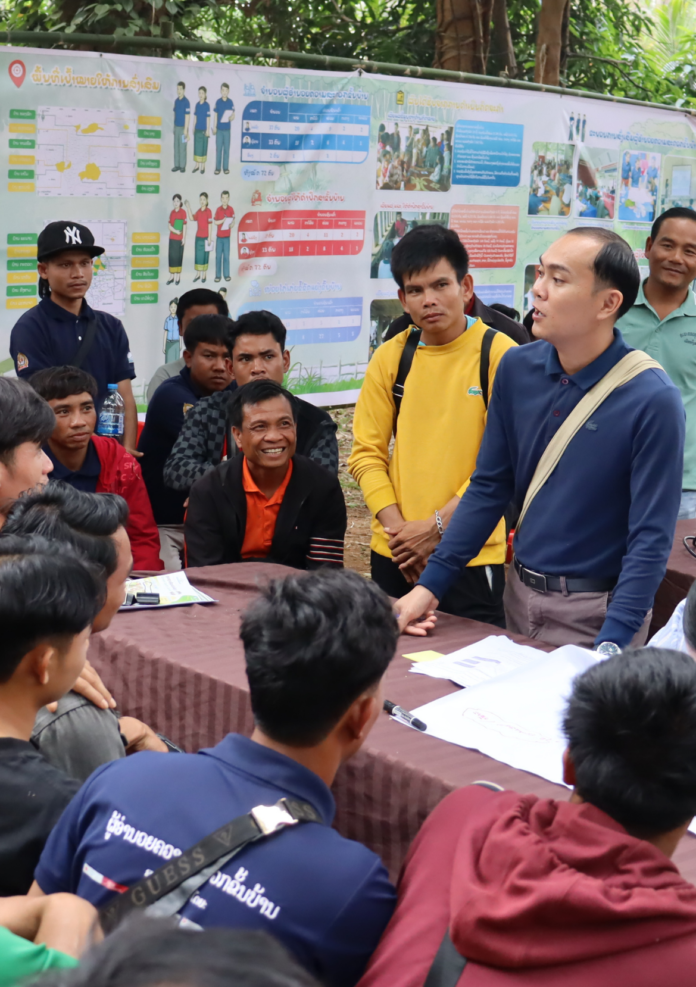
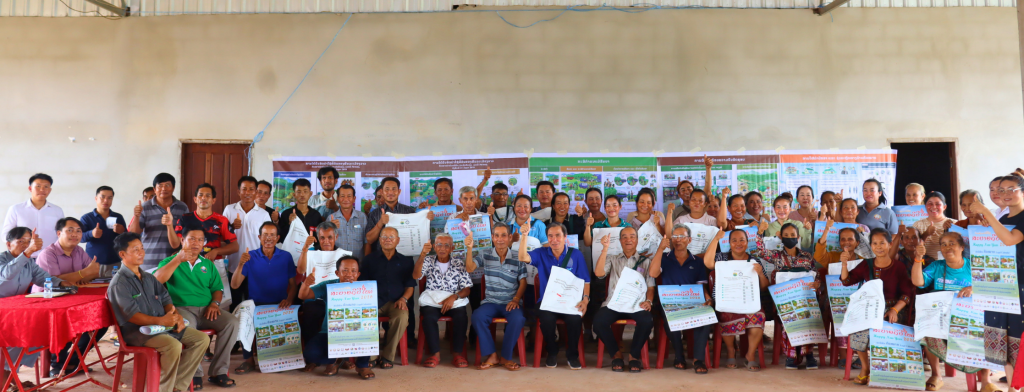
 Community members and local authorities in Pakkading District proudly display their new legal resources. In these rural villages, secured land rights are the ultimate foundation for local livelihoods and survival. Photo: @Helvetas/Soukkanhya Phommalangsy
In rural villages like Nam Thon, Xot, and Phonxay, land is the ultimate foundation of life. For most families here, survival depends on agriculture, with farmers growing rice, planting rubber, and farming cassava. Having secured rights to land means having the freedom to farm and use the land independently, without the daily fear of losing their land or having to seek alternative income-generating activities
Yet, for a long time, the rules governing the land were unclear to the people who lived on it and used it. When disputes over boundaries or linked to inheritance arose, the peace in the village was quickly broken. As reported by local authorities, some villages faced these conflicts up to seven or eight times a year, repeatedly affecting the families involved sometimes on multiple occasions
“I used to feel very anxious when a dispute happened,” shared a community member from Phonxay village. “Sometimes, our family is smaller than the other party’s family, and I worried that during the negotiations, we would unfairly lose our land rights .”
For decades, village authorities tried to resolve these issues using local customs or basic legal explanations. However, as village authorities explained, a major obstacle to true justice was that villagers often relied on misinformation from neighbors or personal relationships rather than formal rules. The new visual posters provided by the project changed this, finally giving mediators the right tools to clearly explain the law and successfully convince people to follow it.
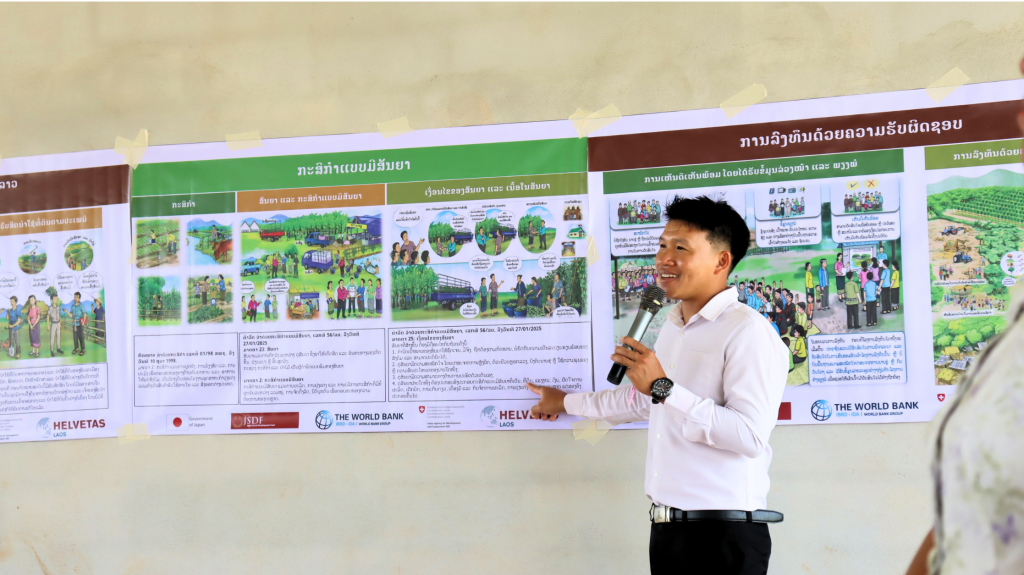 An officer from the Ministry of Justice uses highly visual posters to clearly explain the conditions of contract farming, ensuring that complex laws are easy for everyone to grasp. Photo: @Helvetas/Soukkanhya Phommalangsy
This shift from tradition to truth began with a dedicated initiative. Through the Helvetas-led Public Information and Awareness Services for Vulnerable Communities (PIASVC) project, this is changing. The project trained officials at the provincial and district level, who then on-trained volunteers at village levels, turning local residents into trusted legal guides.
Instead of reading heavy law books, the trainers used visual and community- friendly tools, sometimes also translated in local languages. A village authority from Xot village stressed how helpful this was: “The posters are incredibly useful because the drawings help us visualize the laws clearly, along with deep explanations. It is much better than just trying to explain without pictures.”
With these simple tools, the villagers began to experience a significant shift in knowledge and thus confidence. They learned about the different elements to be careful of when negotiating contracts farming agreement with an investor, about the obligations they have to leave space for public roads or about how to properly upgrade their temporary land documents into official land titles.
“If an investor or neighbor encroaches on my land now, I will follow the law,” said a community member from Nam Thon village confidently. “I will write a formal complaint and send it to the village land office and the mediation unit to protect my rights.”
A community member from Xot village echoed this newfound courage. “In the future, we might not know what will happen to our land, but now we understand our right to protect it,” he said. “Even if the village authorities say something, if it is incorrect, we can now review the law and correct them based on the legal articles.”
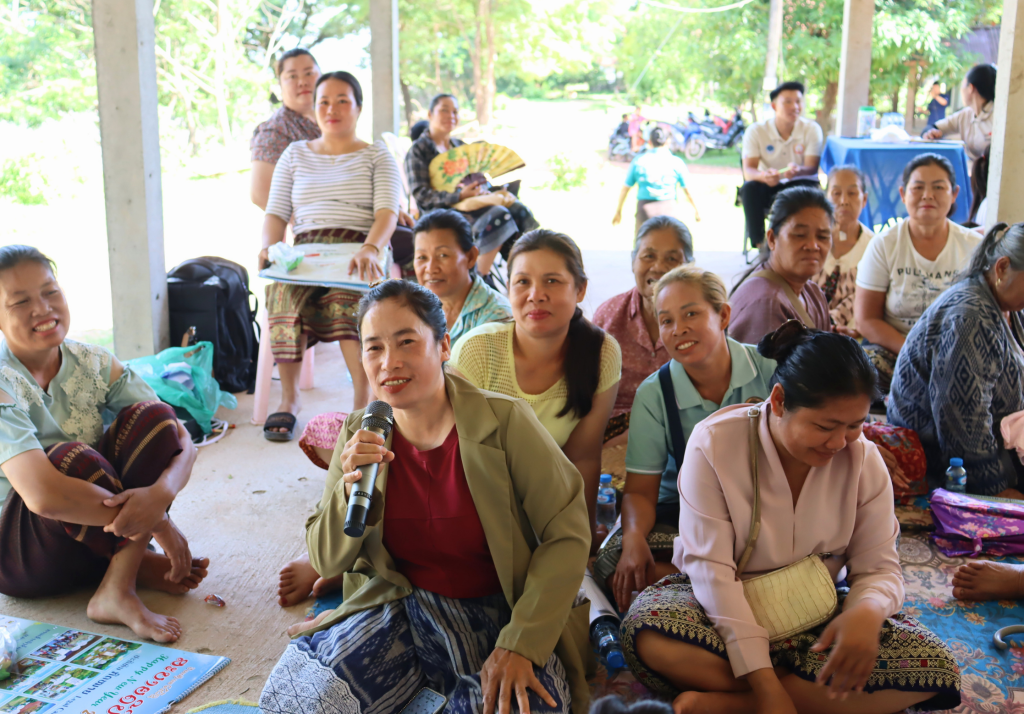 community member smiles confidently as she shares her thoughts and participates in an interactive legal quiz. Through these supportive sessions, villagers especially women are stepping up to protect their families’ futures. Photo: @Helvetas/Soukkanhya Phommalangsy
Village authorities also feel empowered. A village authority from Nam Thon village explained that before the training, they only did basic mediation. Now, the village leadership works as a unified team—bringing together the women’s union, youth, and forestry sectors—to plan their mediations with the law as their main guide.
Trust and confidence built through this PIASVC’s approach has created an incredible wave of proactive change. According to a village authority from Nam Thon village, villagers are now so awakened to the importance of their land rights and aware of their obligations that the authorities have seen a surge in people coming forward to register and pay their land taxes
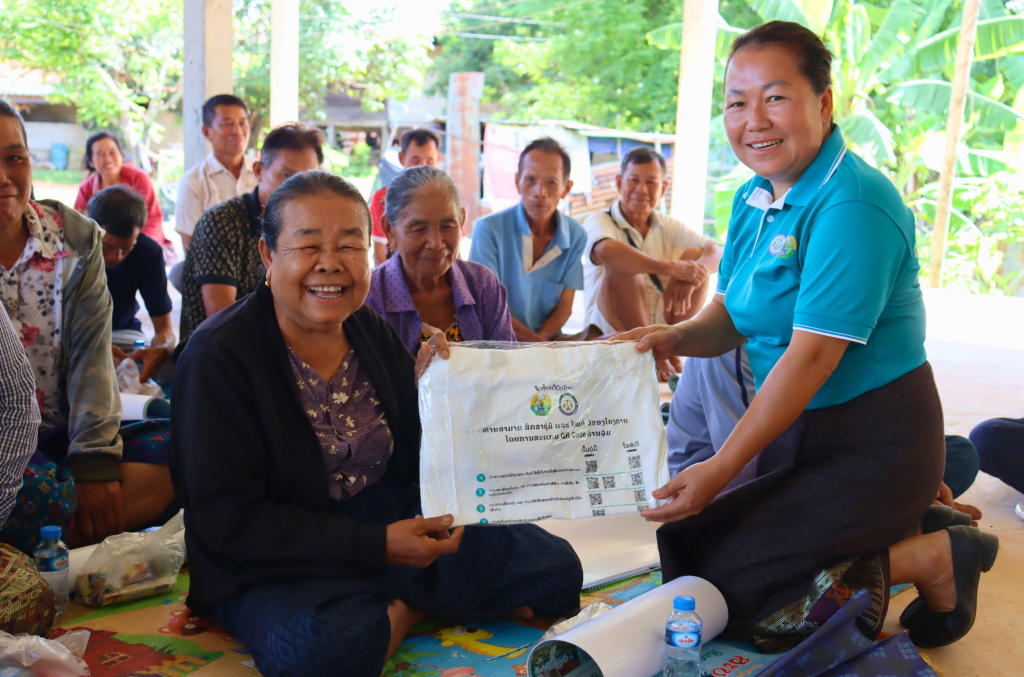 Project activities go beyond standard lectures. Here, an elder receives a specialized resource bag equipped with QR codes, granting her direct and ongoing access to legal information long after the training ends. Photo: @Helvetas/Soukkanhya Phommalangsy
This grassroots success has not gone unnoticed by the central government. A representative from the Ministry of Justice acknowledged that while the government has tried to disseminate laws in the past, limited budgets meant the information rarely reached these remote areas physically. Furthermore, when it did, it was difficult to understand. The project bridged both of these gaps by creating accessible tools like training manuals and visual legal posters that foster true understanding.
A representative from the Lao Front for National Development also reported being deeply impressed by the focus on gender equality. She observed that village chiefs are now successfully gathering both men and women to learn about mediation together, showing strong leadership that will encourage more women to put their names on land titles in the future.
By putting the law directly into the hands of the people, the project helped community members to become empowered citizens, building a more sustainable and equitable future for their families
The PIASVC project is implemented with Association for Development of Women and Legal Educations and Department of Land Administration and Management, Mistry of Agriculture and Environment, and is funded by Swiss Development & Cooperation and Japan Social Development Fund via World Bank Laos